


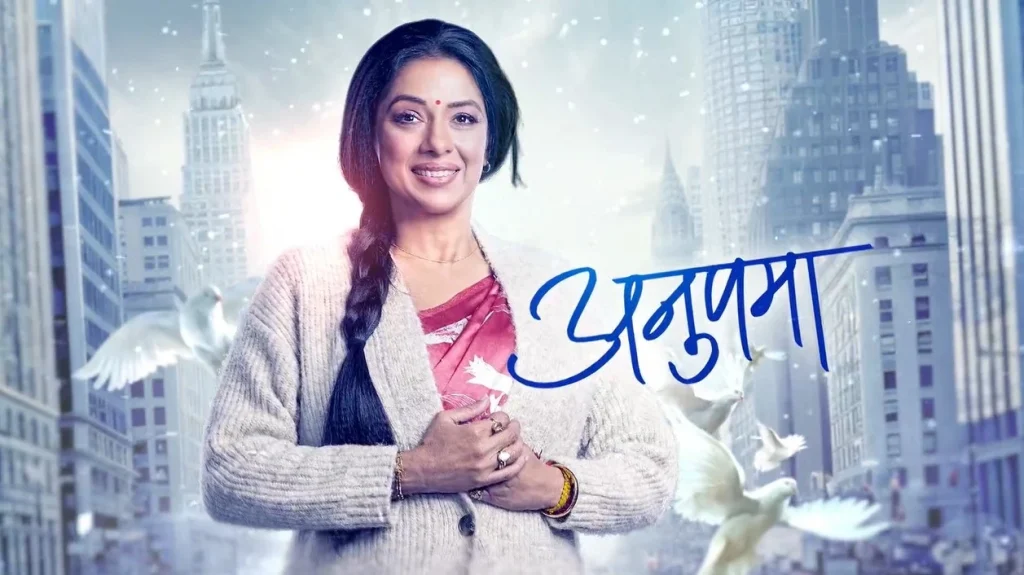
Anupama 31st October 2025 Written Episode, Written Update on TellyUpdates.com
As the car draws near their destination, the driver informs everyone that the resort is close by. Sarita skeptically comments that it must be expensive and suggests they should find a more affordable hotel or a simple dharamshala instead. Meanwhile, Devika calls out to Anupama and pointedly remarks that as long as Anupama’s heart remains tied to the Shah family, she will never find peace in Mumbai. In frustration, Devika snatches Anupama’s mobile phone. Anupama, confused and anxious, questions why Devika is turning it off, worried about possible emergencies. Devika urges her to calm down, reminding her that she is neither a doctor, an ambulance, nor God—just a friend asking her to relax.
Back at the Shah residence, Pakhi grows agitated about Ishani’s wellbeing. The family, startled by Pakhi’s shouts, gathers to question her. Paritosh complains that Pakhi and Ishani’s drama has no end. Offended, Pakhi asks whether he truly believes she is pretending. Leela demands Paritosh to open the door, only for them all to be stunned by the sight of Ishani lying unconscious. Horrified, Pakhi screams after seeing Ishani’s picture and immediately calls for help. Kinjal decides to reach out to Rahi and Ansh for support.
Elsewhere, Anupama grows increasingly uneasy, which Preet quickly notices. When she asks Devika the reason, Devika explains that Anupama’s restlessness stems from her maternal instincts—she is a mother, and thus can never detach from her children. Devika tells Preet they must protect Anupama from the Shahs. Just then, Devika’s phone rings—it’s Kinjal, informing her of Ishani’s condition.
Upon hearing the news, Rahi and Ansh decide to rush to Ishani’s side. Vasundhara dismisses the situation, hinting that Ishani might be faking. Rahi, offended, warns Vasundhara to mind her words. Parag encourages Rahi and Ansh to leave immediately. While Ansh feels restless, Rahi realizes that Prem’s phone is switched off. Vasundhara advises her to keep Prem away from the Shah family. After Rahi and Ansh leave for the hospital, Anil tells Parag they should follow too. Meanwhile, Mahi cynically comments that Ishani only seeks attention and urges everyone not to worry. Vasundhara agrees, convinced Ishani is pretending. Mahi further insists that Ishani is too self-centered to harm herself.
At the hospital, everyone waits with bated breath as Ishani’s condition deteriorates. The doctor urgently asks for an injection, but the nurse almost drops it—until Anupama rushes in at the right moment and saves the situation. Grateful, Leela thanks her for coming back. Overwhelmed with guilt, Pari blames herself for Ishani’s state, while Pakhi breaks down and hugs Anupama emotionally, echoing similar regret.
Meanwhile, Mahi makes a bold move by proposing marriage to Gautam. She promises to help him gain custody of his child and imagines a perfect future together, even as Gautam stands stunned by her unexpected confession.
Back at the hospital, Leela asks Anupama to stay with them. Anupama agrees—at least for now—and tells everyone else to go home. Pari continues to reproach herself for what happened, but Kinjal and Paritosh try to console her.
Meanwhile, at the Kothari mansion, Mahi proudly tells Parag and Vasundhara that their business meeting with the German client was possible only because of Gautam’s efforts. Vasundhara praises him, but Mahi takes the opportunity to criticize Ansh. Prarthana quickly steps in to defend Ansh and challenges Mahi’s growing bias toward Gautam. When Mahi is about to admit her feelings for him, Prarthana sternly warns her to stop.
Later, Rahi invites Ansh to stay for Bhai Dooj celebrations, and even Anupama pleads with him not to leave. But Ansh, weighed down by frustration, says he is paying the price for caring too much about Pari and Ishani at the Kothari house. Exhausted, he declares that he is tired of bearing everyone’s burdens. Left disheartened, Anupama turns to God, asking why He continues to test her and prevent her from moving forward in life.
Precap: Anupama tries to lift everyone’s spirits and encourages the Shah family to celebrate Bhai Dooj together. However, Paritosh refuses to take part in the festival with Pakhi, leaving Anupama stunned and disappointed. In the midst of this, Pari sadly mentions that Ansh won’t be joining the celebration either. Anupama, determined to keep the family united, insists that he will come.
When Ansh arrives, he refuses to perform the Bhai Dooj ritual with Mahi. He accuses her of deliberately trying to sabotage his career for the sake of Gautam. Taken aback, Mahi demands to know why she would ever do such a thing. In response, Ansh boldly reveals that Mahi is in love with Gautam. His revelation leaves both the Shahs and the Kotharis completely shocked and speechless.
Update Credit to: H Hasan

5 Comments
Poor silly Mahi. The bio-Dad may not even know of her existance. Step-dad looked at her as an extra mouth to feed, a reminder of his wife’s infidelity. Bio-mom dropped her like yesterday’s unwanted mess, left her in care of Anupama and mercy of ever chaotic Shahs. AnnuMa cared for her till her own daughter Rahi showed up and then Mahi was back of the line again.
The man she idiotically loves marries her “sister” and the husband she marries as consolation prize turns out to be an addict who dies way too young. She is a widow at young age and Kotharis are clueless about her emotions.
An easy picking for Gautaum. Dhe wants a new life and unfortunately her options are limited. So she falls easy prey to Gautam’s scheaming.
Silly person? Yes. Bad person, Not really.
🌍 United Nations Union Blueprint (Performance-Based World Governance, 2025)
Preamble
We, the citizens of the world, united in spirit and purpose, resolve to establish a just, peaceful, and progressive global union.
We dedicate ourselves to uphold truth, equality, compassion, and shared prosperity among all nations and peoples.
Our aim is to make Earth a secure home and living spaceship, sustained by collective wisdom, innovation, and mutual respect.
Together, we pledge to govern the planet responsibly — ensuring that freedom, health, and dignity are universal rights for every human being.
Through cooperation, science, and moral leadership, we seek to advance civilization beyond conflict and greed — toward a balanced, intelligent, and harmonious world order.
🏛️ World Capital
New York City, USA — Global Capital, symbolizing continuity of UN head quarters , neutrality, and innovation.
Each nation’s capital will serve as a Regional Headquarters, ensuring decentralized governance under one unified umbrella.
⚖️ Initial Foundational Governance
Country Department / Role Responsibility
🇷🇺 Russia Union Leader & Peace Chief First UN President. Leads Global Peace and Security, ensures military balance, oversees nuclear disarmament, space defense, and conflict prevention.
🇫🇷 France Global Constitution Architect Frames the UN World Constitution, combining democratic, humanitarian, and egalitarian principles with guidance from Russia and China.
🇨🇳 China Economic & Development Steward Guides industrial growth, infrastructure modernization, AI economy, and global debt reform.
🇬🇧 United Kingdom Democratic Governance & Human Rights Ensures ethical governance, transparency, and rule of law across all departments.
🇺🇸 United States Innovation, Space & Defense Secretariat Manages space technology, AI research, and advanced global defense systems.
🇸🇬 Singapore Education & Knowledge Development Establishes global learning hubs, teacher accreditation, and education innovation standards.
🇩🇪 Germany Environmental & Energy Sustainability Leads green energy, industrial recycling, and climate restoration policies.
🇨🇭 Switzerland World Health & Biosecurity Coordinates global health systems, medical innovation, and pandemic response centers.
🇳🇱 Netherlands Agriculture & Food Security Ensures sustainable agriculture, water governance, and global food logistics.
🇯🇵 Japan Digital Infrastructure & AI Governance Builds cyber governance, robotic policy frameworks, and data protection systems.
🇰🇷 South Korea Mobility & Smart Transport Develops AI-driven transportation, electric mobility, and smart city integration.
🇮🇳 India Global Service Directs IT systems, healthcare delivery, citizen-service technologies, and global ethics training.
🇨🇦 Canada World Justice & Ethical Oversight Maintains global judiciary standards, integrity audits, and international court coordination.
🇸🇦 Saudi Arabia Energy & Resource Transition Oversees oil diversification, renewable resource balance, and energy equity.
🇮🇹 Italy Culture & Tourism Heritage Protects heritage sites, promotes sustainable tourism, and cross-cultural dialogue.
🇮🇸 Iceland Marine & Polar Research Leads Arctic cooperation, climate data mapping, and marine resource preservation.
🇹🇷 Turkey Humanitarian & Crisis Management Coordinates disaster relief, refugee programs, and peace mission logistics.
🇿🇦 South Africa Continental Growth & Youth Empowerment Strengthens industrialization, skills training, and youth entrepreneurship across Africa.
🇱🇰 Sri Lanka Spiritual & Moral Harmony Council Promotes interfaith dialogue, meditation initiatives, and ethical education.
🇦🇪 United Arab Emirates Space & Extraterrestrial Research Command Directs space exploration, satellite networks, and planetary collaboration policies.
⚙️ Institutional Framework (Set in Every Country)
Institution Structure Function
World Court Present in each country’s capital as a Regional World Court under Canada’s Global Justice Department.
Adjudicates cross-border disputes, corporate violations, and human rights cases using a unified global legal charter.
Supreme Court of Humanity (Central) Based in Geneva, Switzerland.
Serves as the final appellate body for all international legal disputes and moral violations.
World Military Command Headquartered in Moscow (Russia); regional bases in every country under UN Peace Force.
Prevents wars, oversees disarmament, and deploys peacekeeping AI forces jointly operated by all member states.
Global Healthcare Network (GHN) Coordinated by Switzerland with hospitals in every nation linked via a cloud medical record system.
Ensures universal healthcare, disease prevention, and emergency coordination under Biosecurity Command Centers.
World Educational Institutes (WEI) Managed by Singapore, with one UN Global University Campus in every country.
Provides standardized curricula, moral education, digital literacy, and free cross-border degrees.
Global Service Command (GSC) Led by India, with service hubs in every country capital.
Delivers digital governance, citizen services, public response, and training in ethical service leadership.
Global Research & Innovation Board (GRIB) Led by USA and Japan.
Oversees AI, space, defense, and biotechnology innovations ensuring equitable tech distribution.
World Environmental Taskforce (WET) Directed by Germany with satellite labs worldwide. Implements carbon control, forest regeneration, and eco-industrial transition programs.
🌐 Governance Principles
Performance-Based Leadership: Nations gain influence by measurable outcomes — sustainability, innovation, equality, and transparency.
Representation determined by competence, not size or power.
Unified Military Code: No independent national armies — all under the UN Peace Force Command.
Transparency Charter: Every decision digitally logged on public blockchain for global viewing.
Universal Education & Healthcare Rights: Guaranteed in every nation under a single charter.
Rotation of Union Presidency: Every 5 years, leadership rotates among top-performing nations after Russia’s foundational term.
Sonam Wangchuk is included in TIME100 Climate 2025 — the list of “100 most influential leaders driving business-climate action”.
The article notes his work in the high Himalayas (Ladakh), where he revived and modernised the ancient technique of creating artificial glaciers / “ice stupas” to alleviate water scarcity.
It emphasises that he comes from Ladakh (at ~11,500 ft elevation), where water is scarce and glaciers are receding. His innovation combines engineering, climate mitigation, and traditional knowledge.
The piece mentions his arrest during a protest for autonomy in Ladakh, adding a dimension of activism to his climate-work.
🎯 Why it matters
Recognition by TIME validates Wangchuk’s approach of locally rooted innovation (in Ladakh) scaled to global relevance.
It places climate action not just in labs or big cities, but in remote, vulnerable communities — showing that high-altitude deserts too can contribute to climate resilience.
Bringing together tradition (glacier culture), engineering (ice stupas) and activism (region’s rights) gives his story a multilayered impact.
—————
Congrats Sir and Ma’am.
His recognition by TIME shows how his fight for the environment is also a fight for people’s rights and fair government decisions.
#FreeSonamWangchuk.
https://www.youtube.com/watch?v=NJOzzZ-bcoc
—————-
Mass migration reflects that the parent country or region is deeply underdeveloped.
Basic necessities like healthcare, education, skill development, clean environment, judiciary and employment opportunities must be available in every area.
When these needs are fulfilled, people will prefer to stay, serve one another, and develop their own region and technology instead of migrating elsewhere.
——————–
Religion, should never become a political or social agenda.
It is a matter of personal freedom and inner choice, something people can truly experience only when they are educated and financially independent.
I am a Hindu, yet I love Jesus deeply—perhaps more than many Christians do.
In my Puja room, the image of Sufi Saint Sai proudly shares space with Lord Jesus.
When I choose Yoga or when I do Zumba should remain my personal decision, free from interference or judgment.
Empowerment is connected with spiritual independence.
When individuals have education, skills, financial security, they gain the confidence to think freely, choose freely, and live without fear or manipulation.
A society that respects such freedom of thought and worship naturally moves toward peace and progress.
But when politics becomes radicalized in the name of religion, it only leads to division, violence, and regression, creating more Pakistans and Talibans instead of prosperous, enlightened nations.
To prevent such outcomes, the United Nations must play a stronger role in empowering local communities, developing every each of Earth.
By ensuring universal access to education, healthcare, clean environments, and fair employment, the UN can help transform vulnerable regions into self-reliant ecosystems.
Such global cooperation would reduce helpless migrations, promote dignified livelihoods, and enable people everywhere to live with freedom, faith, and dignity in their own homeland.
We need a death, come on, someone die.